
TB-500 peptides are Synthesized and Lyophilized in the USA.
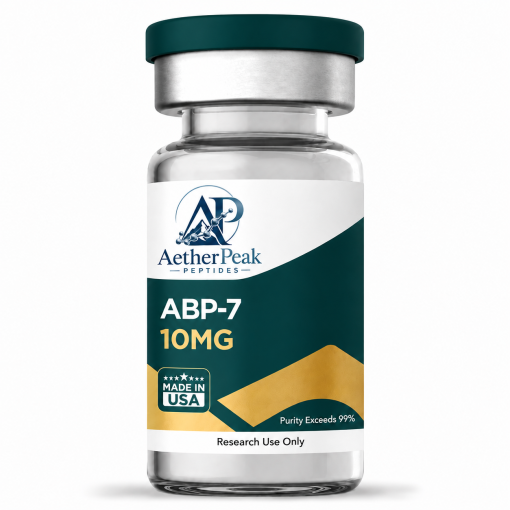
Size: 10mg Contents: ABP-7 Form: Lyophilized powder Purity: >99%
| Quantity | 5 – 9 | 10 + |
|---|---|---|
| Discount | 5% | 10% |
| Price | $87.40 | $82.80 |
Original price was: $87.00.$80.00Current price is: $80.00.
TB-500 (ABP-7), also known as Actin-Binding Peptide-7 or Ac-LKKTETQ, is a high-purity synthetic heptapeptide that represents the core active actin-binding domain of the naturally occurring protein Thymosin Beta-4 (Tβ4). Offered in a convenient 10mg lyophilized vial, this research peptide is a valuable tool for scientists investigating cellular migration, wound healing, angiogenesis, and tissue regeneration mechanisms.
As interest in regenerative biology continues to grow, TB-500 (ABP-7) has become a focal point in preclinical research due to its targeted action on actin dynamics — a fundamental process in cell structure, movement, and repair. This detailed guide explores the product’s specifications, mechanism of action, research applications, and practical laboratory considerations for researchers exploring tissue repair peptides.
TB-500 (ABP-7) is a compact, N-acetylated heptapeptide designed for high specificity in laboratory models.
| Property | Specification |
|---|---|
| Primary Name | TB-500 (ABP-7) |
| Alternative Names | Actin-Binding Peptide-7, Ac-LKKTETQ, Thymosin Beta-4 Fragment (17-23), TB-500 Fragment |
| Amino Acid Sequence | Acetyl-Leu-Lys-Lys-Thr-Glu-Thr-Gln (Ac-LKKTETQ) |
| Molecular Formula | C₃₈H₆₈N₁₀O₁₄ |
| Molecular Weight | Approximately 889.02 g/mol |
| CAS Number | 885340-08-9 |
| Purity | ≥99% (HPLC and MS verified, batch-specific COA) |
| Appearance | White to off-white lyophilized powder |
| Solubility | Soluble in sterile or bacteriostatic water |
| Storage (Lyophilized) | -20°C for long-term stability |
This smaller fragment offers researchers a more precise model compared to the full-length 43-amino-acid Thymosin Beta-4 (molecular weight ~4963 g/mol), allowing focused study of actin-binding effects.
The primary mechanism of TB-500 (ABP-7) involves high-affinity binding to G-actin (globular actin) monomers. By sequestering G-actin, the peptide modulates its polymerization into F-actin filaments, which are essential for cytoskeletal reorganization, cell shape maintenance, and motility.
This actin regulation triggers several downstream processes critical to tissue repair:
Because ABP-7 contains the key actin-binding domain of Thymosin Beta-4, many researchers consider it the minimal active sequence responsible for significant regenerative signaling. Studies suggest it may promote faster cell recruitment to injury sites and support more organized tissue remodeling.
TB-500 (ABP-7) is extensively studied in preclinical models for its potential role in regenerative medicine. Primary research areas include:
1. Wound Healing and Skin Repair Preclinical investigations show that the peptide may accelerate wound closure, enhance re-epithelialization, and reduce scar formation through improved fibroblast migration and collagen organization.
2. Musculoskeletal and Soft Tissue Recovery Research models involving muscle, tendon, and ligament injuries explore how ABP-7 supports recovery by promoting cell migration and angiogenesis, potentially improving flexibility and reducing downtime in experimental injury settings.
3. Angiogenesis and Vascular Studies The peptide’s ability to stimulate new blood vessel formation makes it a tool for cardiovascular and ischemia-related research, where enhanced nutrient delivery to damaged tissues is critical.
4. Anti-Inflammatory and Immune Modulation Some studies indicate potential modulation of macrophage polarization toward anti-inflammatory phenotypes, supporting a more favorable healing environment.
5. Cellular Biology and Actin Dynamics As a precise probe, ABP-7 is used to dissect cytoskeletal processes in cell culture and in vivo models.
Note: All referenced findings come from in vitro and animal studies. Human clinical data is limited, and TB-500 (ABP-7) is strictly for laboratory research use only.
| Aspect | ABP-7 (Heptapeptide) | Full-Length Thymosin Beta-4 / Larger TB-500 |
|---|---|---|
| Length | 7 amino acids | 43 amino acids |
| Molecular Weight | ~889 Da | ~4963 Da |
| Primary Focus | Targeted actin-binding and cell motility | Broader multi-domain regenerative effects |
| Research Advantage | Higher specificity, simpler model | Systemic effects in whole-organism studies |
| Common Applications | Localized tissue repair models | Comprehensive wound healing and recovery |
| Solubility & Handling | Excellent | Good |
This comparison helps researchers select the most appropriate tool for their specific experimental goals.
For optimal results in laboratory settings:
| Quantity | 5 – 9 | 10 + |
|---|---|---|
| Discount | 5% | 10% |
| Price | $87.40 | $82.80 |

Reviews
There are no reviews yet.